


Methodist Roots
In Methodist Roots, a special teaching series with our Assembly of Bishops, you’ll discover the history of Methodism and understand how key features of the faith influence the church today. Watch the video below and download the study guide to participate in weekly lessons.
Watch Methodist Roots
Start by watching the Methodist Roots video. This video was filmed in the United Kingdom and features significant Wesleyan sites that connect us to our Methodist heritage.



Join the study
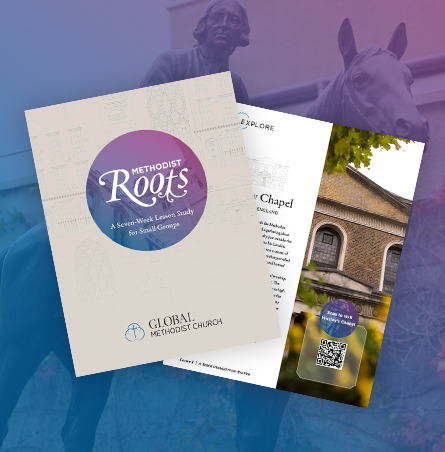
After watching the video, use the study guide to dive deeper into the topics with your church, small group or in your personal devotional time. Each week is a new lesson. Throughout the series, you’ll also learn about important and sacred places that serve as a reminder of God’s faithfulness and calling.
Download the study guide in your preferred language:
Featured Wesleyan Sites
Experience snippets of significant Wesleyan sites – from Wesley’s Chapel in London to Charles Wesley’s home in Bristol.
Wesley’s Chapel – London, England
John Wesley was meeting with the Methodist society in London and needed a gathering place. He acquired a ruined cannon foundry just outside the city and repaired it. The Foundery was his London headquarters from 1739 until 1778. It was a center of Methodist preaching and activity, a space that provided a home for John and his mother Susanna and housed London’s first free medical dispensary.
Wesley Chapel was built for sacramental worship, including an altar in the apse behind the pulpit. The current pulpit is raised up, but is only two-thirds as high as the original. John Wesley in his journal describes the building as “perfectly neat but not fine.” Over its many years, various memorials have been added to remember key figures in British Methodism. King George III donated wooden pillars for the balcony which have been replaced by marble ones at the chapel’s centenary. The crypt now houses the Museum of Methodism.
The chapel is a functioning church with several weekly worship services and other ministries.
John Wesley’s House – London, England
John Wesley’s House was built soon after the construction of the Wesley Chapel. Previously, John Wesley had resided in the Foundery, but in 1779 this became his home. One floor was for his use and other floors were for visiting preachers. The front room was his study and contains his desk and some of his library. The windows look west onto Bunhill Fields and his mother’s grave. The bed in which he died was sold in the 1800’s, but a similar one is in the bedroom now. Just off the bedroom is a small closet where he prayed regularly. The house has been restored to reflect an 18th century décor.
Bunhill Fields Burial Ground and Susanna Wesley Gravesite – London, England
Bunhill Fields (shortened from “Bonehill”) was used as a cemetery for London’s citizens who were not members of the Church of England. They were called Dissenters because they worshiped in other Christian churches, thus dissenting from the Book of Common Prayer. Persons buried there include John Bunyan, the author of Pilgrim’s Progress, Daniel Defoe, author of Robinson Crusoe and the hymnwriter Isaac Watts. Susanna Wesley was buried there upon her death in 1742. This is the cemetery closest to the Foundery. While she was a member of the Church of England and the wife and mother of Anglican clergy, her grandparents were all dissenters.
Charles Wesley House – Bristol, England
In contrast to his older brother, Charles Wesley had a happy marriage. Sarah Gwynne was from northern Wales and believed strongly in the Methodist movement. They married in 1749 and moved to Charles Street in Bristol. Charles was an itinerant preacher like his brother and shared in leadership of the Connection. However, his happy homelife and his calling as a hymn-writer led him to stay at home more than John did. Over his lifetime he wrote more than 8,900 hymns. He and his brother published many different hymnbooks. Charles and Sarah lived in this Bristol house for 22 years and had eight children, only three of whom survived infancy. Their sons Charles and Samuel became well-known church musicians.
Pill Sailing Site – Pill, England
In the 1700’s, Bristol was the second largest city in England and the primary port for those sailing to America. Ships would anchor in deep water and passengers would take a smaller boat from shore out to ship. One of those launching places was a village near Bristol called Pill. From this site, Thomas Coke, Richard Whatcoat and Thomas Vasey set sail from Pill for America on September 18, 1784. A few days earlier John Wesley had ordained Whatcoat and Vasey as deacons and elders, and set apart Coke as a general superintendent for the work in America. At the Christmas Conference in Baltimore, the American preachers elected Coke and Asbury as bishops and Coke ordained Asbury as deacon and elder, and then consecrated him as bishop on consecutive days.
John Wesley’s New Room – Bristol, England
With the Moravians and others, John Wesley formed religious societies to help people find salvation. There were two societies in Bristol, but after he started preaching outdoors, many more people joined the societies. To provide space for the growing groups, Wesley obtained land in a district of Bristol called the Horsefair and built a building. It is the oldest continuously used Methodist worship space in the world, dating back to 1739. It was used for preaching services, class meetings, a medical dispensary and services for the poor. Starting in 1744, Methodist preachers in connection with John Wesley met for a conference annually, and some of them were held in the New Room.
Christ Church Oxford
John Wesley went up to Oxford from his time at the Charterhouse School in London. His college was Christ Church, perhaps the most prestigious of the colleges that made up the University. He graduated in 1725 and started studying for his ordination examinations. That year, he read Bishop Jeremy Taylor’s
Rules and Exercises of Holy Living and Holy Dying. He realized that it was very important to measure how he spent his time. He began keeping a diary to gauge his progress toward holiness. The next year he was elected a Fellow of Lincoln College.
Hanham Mount
John Wesley first preached out of doors on April 2, 1739. He said that prior to this, he had been “so tenacious of every point relating to decency and order that [he] should have thought the saving of souls
almost a sin
if it had not been done in a church.” Watching George Whitfield and experiencing the large crowds, he realized that field preaching was a way of reaching the people. Hanham Mount became one of his regular places for outdoor preaching. For the rest of his life Wesley insisted that carrying the gospel to where the people gathered out of doors was an important part of Methodist ministry.